From molecule to mirror: Croda Beauty's integrated hair care capabilities

How Croda Beauty connects consumer insight, molecular design, advanced hair science, formulation expertise and real-world validation to create meaningful hair care innovation.
For brand owners and formulators, translating consumer expectations such as “stronger hair” or “healthier-looking hair” into measurable, substantiated product benefits is a complex challenge. What does stronger hair mean scientifically? What needs to change within the fibre, how can those changes be measured, and how do we establish whether consumers will notice a difference?
When consumers talk about their hair, they rarely talk about molecules or measurements. They talk about how their hair looks, feels and behaves. And, importantly, how it makes them feel. Hair is an expression of personal identity, individuality and confidence, and what consumers want from their hair can be deeply personal.
Meeting these expectations takes more than developing a new ingredient and testing it at the end. It starts with understanding what matters to consumers and working backwards to establish what science needs to deliver.

1. Start with the benefit, then work backwards to the science
Innovation traditionally started with a new molecule or technology, followed by exploring what it can do. But at Croda Beauty we start with the question: what benefit do we want to deliver for the consumer?
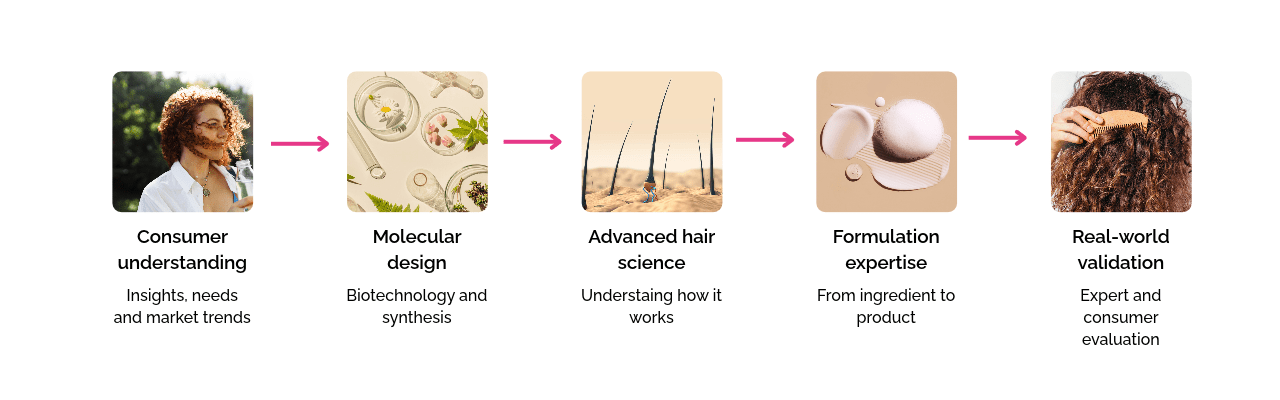
At Croda Beauty, one connected innovation ecosystem brings together consumer understanding, market expertise, biotechnology, synthesis, advanced hair science and formulation expertise. This enables us to work backwards from the desired consumer benefit to identify the molecular characteristics needed, fine-tune them through advances in biotechnology, and build a robust chain of evidence linking molecular interactions to consumer-perceivable performance.
KeraBio™ K31 illustrates this integrated approach. The innovation journey began with the ambition to develop an advanced hair repair bond builder through a biotechnology-powered, biomimetic interaction with hair keratin, rather than with an ingredient in search of a claim.
This objective informed the technology's development and the evidence needed to evaluate its performance. Advanced characterisation, mechanical testing, formulation studies, salon evaluation and consumer research helped build a connected picture of performance, from molecular interactions to the consumer experience.
2. A consumer claim is rarely one scientific phenomenon
Consider the language consumers use around damaged hair: “repair”, “strength”, “healthy-looking” or “less breakage”. These sound like single benefits, but scientifically they can represent multiple challenges that need to be addressed.
To understand whether an approach can support damaged hair, we might ask:
- Can we see evidence of an interaction with the hair's keratin structure?
- What is happening within the fibre?
- Has the internal structure of the hair changed?
- Is the fibre more resistant to mechanical stress or repeated damage?
- What happens at the surface?
No single test can answer all these questions. Raman confocal spectroscopy, for example, can be used to investigate changes associated with disulfide bonds in the hair, while other approaches can assess mechanical performance and damage resistance. By combining complementary methods, we can build a more complete understanding of how an ingredient affects the fibre.
Our global R&D network brings together expertise in chemical synthesis, biotechnology, formulation, supported by a broad range of hair evaluation capabilities. The aim is not simply to run more tests, but to select the right combination to support the performance claim.
3. The most interesting question is often what happens between the molecule and the mirror
Understanding what happens to the hair is only part of the challenge. We also need to understand how ingredient technologies can be developed, screened and translated into formulations that deliver meaningful benefits.
At Croda Beauty, our R&D approach brings together three complementary capabilities: Make, Screen and Apply.

Make, advances ingredient technologies through approaches including biotechnology and synthesis. Screen, accelerates the evaluation of potential solutions using tools such as robotics, data analytics and AI, helping identify promising ingredients and combinations. Apply, connects ingredient and formulation science to consumer-perceivable benefits, from sensory experiences and active delivery to hair repair.
These capabilities inform one another throughout the innovation process, helping connect ingredient science to formulation performance and, ultimately, the experience of the hair.
Salon evaluation adds another layer of evidence. Working with a trained cosmetologist allows attributes such as manageability, combability, feel and appearance to be assessed in a controlled environment. It helps answer a practical question: can the scientific difference actually be observed in the hair?
4. So why does this matter to Croda’s customers?
By connecting capabilities across the innovation journey, Croda Beauty helps our customers:
- Translate consumer needs into clear scientific and performance targets.
- Accelerate the identification and development of promising technologies.
- Build robust, multidimensional evidence for differentiated claims and product stories.
- Develop relevant solutions validated through laboratory, expert and consumer perspectives.
5. And can the consumer actually experience the difference?

Laboratory and expert evaluations help us understand how an ingredient affects hair, but consumers experience products in the context of their own routines. Washing frequency, combinations of products, heat styling and colouring can all influence how hair looks and feels.
At-home studies therefore provide more than another efficacy measurement. They help answer whether a benefit is noticeable, relevant and meaningful in everyday life.
Our KeraBio™ K31 consumer panel provides an example of how scientific findings and expert evaluation can be complemented by consumer research. In consumer salon studies, panellists reported that their hair looked healthier, felt healthier and experienced less breakage. These findings demonstrate the importance of evaluating performance from multiple perspectives: laboratory measurements help explain what is happening to the hair, expert assessment considers observable and tactile performance, and consumer research explores whether the benefits are noticeable and meaningful to those using the product. Find out more in our salon study infographic: KeraBio K31 Salon Study Infographic | Croda Beauty
Together these levels of evidence help answer five important questions:
- What happens to the molecule?
- What happens to the hair?
- Can an expert see or feel the difference?
- Does the consumer notice it?
- Is that difference meaningful to them?
6. There is no single definition of successful hair care performance

Hair characteristics, climate, water quality, styling practices, colouring habits, washing routines and cultural expectations all influence how consumers care for and experience their hair. This means that “better hair” does not necessarily mean the same thing everywhere.
Someone managing highly textured hair may prioritise different attributes from someone looking for sleekness in a humid climate. Someone with heavily chemically treated hair may have a different definition of strength or damage from someone with virgin hair.
Global hair care innovation requires more than taking the same test and repeating it in different countries. The consumer need should help determine what success looks like, and therefore what we choose to measure.
Our R&D network spans Europe, North America, Asia and Latin America connecting specialist capabilities with regional knowledge and consumer understanding across the UK, France and Italy to the US, Canada, Brazil, Mexico, India, China, Japan, South Korea, Singapore, Thailand and Indonesia.
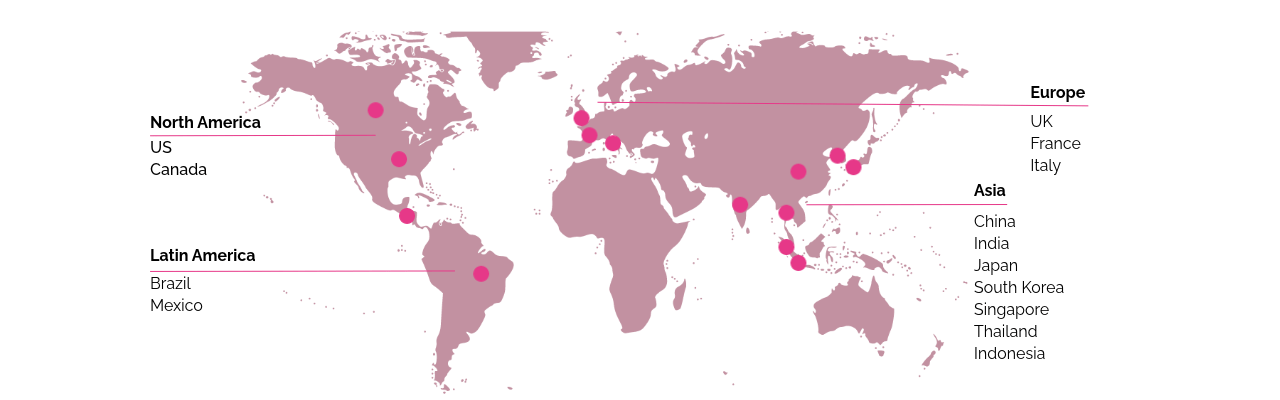
This reach helps ensure that testing reflects the conditions and priorities that matter to consumers. Humidity, for example, may make frizz control a more relevant performance measure, while hair texture and styling routines can influence how we investigate manageability, strength and damage resistance.
By combining robust scientific methods with regional insight, we can develop and evaluate solutions that are relevant to diverse hair types, routines and expectations.
Connecting the dots, from molecule to mirror

Meaningful hair care innovation depends on connecting consumer understanding, molecular design, ingredient science, formulation expertise and real-world evaluation. Each capability contributes a different perspective, helping establish not only how an ingredient works, but how its performance translates into a product experience. For our customers, this means a more connected approach to translating consumer needs into scientific targets, developing promising technologies and building robust evidence for differentiated hair care claims. whether we can connect what happens at the molecular level with what the consumer ultimately sees, feels and experiences.Ultimately, the question is not simply whether an ingredient works. It is That is where science becomes meaningful hair care innovation. Want to explore how Croda Beauty's hair evaluation capabilities could support your next formulation challenge? . Our experts are here to help you explore the best solutions for your brand