Sustainable hero ingredients - crafting the next chapter of peptides

Two technologies are helping drive this evolution: Group Assisted Purification Peptide Synthesis, or GAP-PS, and synthetic biology. Together, they show how peptide innovation is becoming not only more effective, but also more sustainable, precise, and scalable.

GAP-PS
GAP-PS is a smarter way to manufacture bioactive peptides. It combines the strengths of solid-phase peptide synthesis and liquid-phase peptide synthesis while avoiding some of the limits of both traditional routes. In conventional peptide manufacturing, production often relies on petrochemical-derived solvents, generates significant organic waste, and may require long processing times. GAP-PS aims to simplify this process by improving solubility control, increasing yield, reducing solvent use, and making purification easier
 A key feature of GAP-PS is the GAP anchor, which helps control the solubility of the peptide during synthesis. This improves the peptide’s behavior in the reactor, makes separations faster, and can even allow longer peptides to be produced more efficiently. This one-pot technology supports high-concentration reactions, minimal excess reagents, and high crude purity, while reducing solvent use and waste by up to 80%. GAP-PS can also eliminate the need for chromatography and lyophilisation in some processes, which makes the overall manufacturing route simpler, faster, and lower-impact.
The sustainability benefits are central to the way GAP-PS is positioned. This method can deliver a major reduction in process mass intensity, with a much lower environmental footprint than standard solid-phase synthesis. It is also free from CMR and TFA reagents, which is important for both regulatory and environmental reasons. In this sense, GAP-PS is not just a technical improvement; it is a manufacturing platform designed to meet the cosmetic industry’s growing need for cleaner, more responsible ingredient production.
From sustainability to delivery, discover our latest peptide innovation: Matrixyl Neolide™, smart science makes it better, faster, stronger.

Matrixyl® Neolide™
Synthetic biology
Synthetic biology is the second major technique, and it takes a different route to peptide creation. Rather than building peptides only through chemical synthesis, synthetic biology uses engineered living systems, typically genetically modified microorganisms, to produce targeted biomolecules. The process starts with target selection and sequence design, often inspired by human proteins, such as keratin. Advanced computational methods help identify and optimise the sequence, which is then encoded into DNA and inserted into a microbial host.
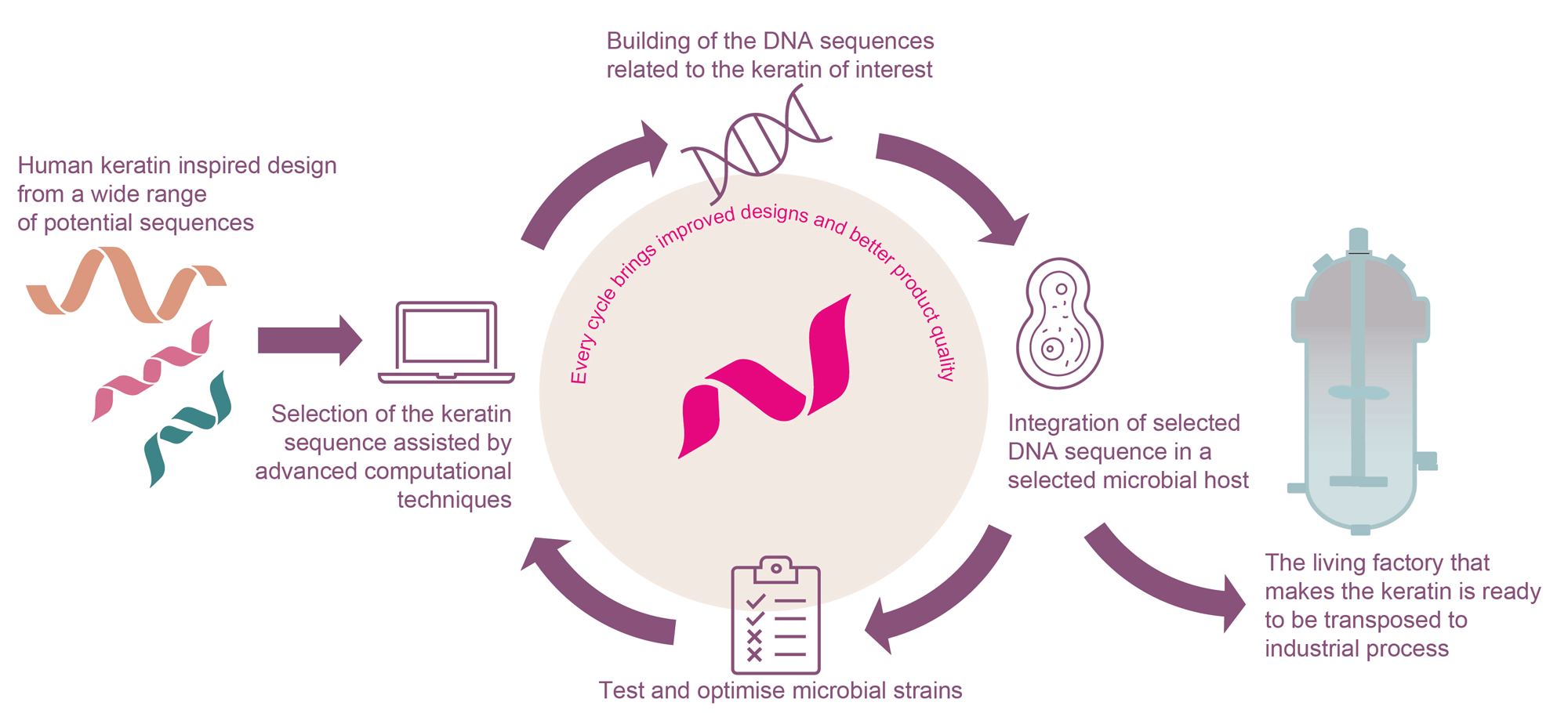
Once the microorganism is engineered, it acts as a living factory. Under carefully controlled culture conditions, it produces the target sequence with high reproducibility and traceability. The biomass is then harvested and processed through downstream steps such as extraction, purification, solubilization, and preservation. This approach supports industrial scale-up, including volumes of 6,000 liters and beyond, while maintaining consistency and product quality.
One of the strongest advantages of synthetic biology is precision. Because the final molecule can be designed to match a human sequence, it offers biomimetic performance and high compatibility with hair or skin biology. This route reduces land use, avoids animal origin, reduces solvent use, and improves reproducibility. In cosmetic applications, this can be especially valuable for ingredients that are difficult or impossible to obtain through traditional sourcing.
KeraBio™ K31 is an example of what synthetic biology can achieve. This keratin-based ingredient is a human-hair-identical protein created through synthetic biology, with intact active sites and strong repair performance. It is a highly potent and sustainable alternative to animal-derived keratin, illustrating how biotechnology can deliver both functional benefits and environmental progress.
In summary, GAP-PS and synthetic biology represent two complementary paths toward the future of peptide innovation. GAP-PS improves the chemistry of peptide manufacturing, while synthetic biology rethinks the biological source of the ingredient itself. Both techniques support the same broader goal: creating high-performance cosmetic actives with better precision, lower environmental impact, and stronger alignment with sustainability expectations.